


FROM PEAKS TO PLATEAUS

Updated: Apr 11
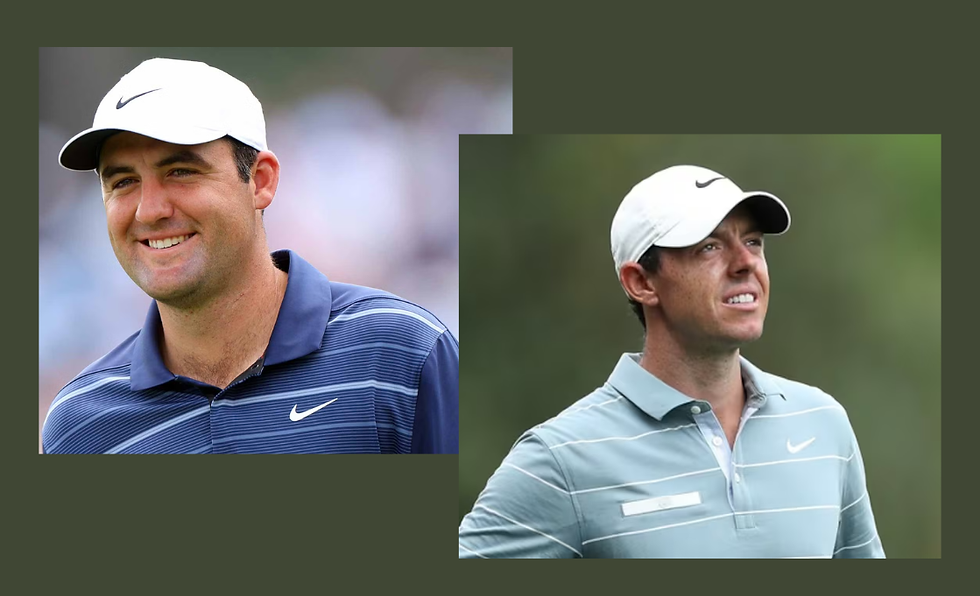
As the 90th Masters tees off at Augusta, we look at the eternal battle between brilliance and consistency…
Today sees the start of the US Masters Golf, always the first Major of the 2026 season and the only one to be played on the same course every year. This year’s edition, the 90th since the event’s creation in 1934, will once again see the cream of the professional golf world go head-to-head over four days at the Augusta National Course, and once again, the battle will be between inspired genius and sheer, bloody-minded consistency …with luck shuffling the pack of course.
Last night, in the UEFA Champions’ League, six times winners Liverpool were beaten 2-0 by Paris Saint Germain ( 1 x Champions League title ) and from all accounts Liverpool got off very lightly.
500 miles away at the Camp Nou, FC Barcelona, five time holders, were also beaten 2-0 by Atletico Madrid who have yet to win the trophy in spite of reaching the Final on three occasions.
While the club leading this year’s Champion’s League, Arsenal, who are also currently leading the English Premier League by 11 points, were knocked out of the FA Cup five days ago by Southampton, currently sixth place in The Championship.
And a mere ten days after Bosnia Herzegovina prevented Italy from competing in this year’s World Cup, a trophy the Azzurri had picked up on four occasions.
But back to Augusta, where seven of the top twenty prospects are former winners, ranging from the defending champion, Rory McIlroy, who took seventeen attempts to win his Green Jacket, as opposed to Scottie Scheffler, who won on his third attempt, in 2022, and then went on to win again, two years later, in 2024. And perhaps no two players currently in contention better represent the clash between genius and consistency than Scheffler (currently ranked No.1 in the world) and McIlroy (ranked No. 2) ; McIlroy with his phenomenal peaks and seemingly inexplicable troughs versus Scheffler with his week-in, week-out plateau of performance.
Of course, Sport is not the only Chapter of The Business of Pleasure where consistency, or rather the lack of it, runs through the very core like a stick of Brighton Rock. Indeed, the massive gap in quality between Shakespeare’s greatest works like King Lear or Hamlet, compared to his All’s Well That Ends Well, is more like the divide between Tiger Woods in his prime and your average Golf Range Sunday driver with a massive hangover.
And there was more than 2 millimetres of vinyl between the ‘Double A sides’ on the Beatles 1966 single: Eleanor Rigby / Yellow Submarine.
But when the stakes are sky high and you’re performing live ..and you only have a limited time in which to work your magic (be that four days or ninety-minutes) …in front of a massive audience (the 2025 US Masters saw a worldwide audience of around 20 million) then the pressure is really on, for all but the very few.
Under Pressure (dumdedy, dum-dum!)
A snappily-titled 2015 paper* ‘Choking under pressure: the neuropsychological mechanisms of incentive incentive-induced performance decrements’ opens as follows:
‘At the 2004 Olympics in Athens, in the men’s 50m rifle event, Matthew Eammons was only one shot away from a gold medal. He fired. It was a bull’s eye. Only the wrong target.’
The author then goes on to outline three theories that may account for Eammons' (luckily not fatal) mis-shot:
Choking via distraction:
Attention is a key component in cognition and sensorimotor performance. Two prominent attentional models have been proposed to explain the detrimental effects of performance pressure. The distraction theory proposes that pressure causes a distracting environment thereby drawing performers’ attention away from skill execution. Attentional focus is shifted to task-irrelevant cues, such as worries about the consequences. In working memory intensive tasks, such as mathematical problem solving, these mental distractions compete for and reduce working memory capacity that would otherwise be needed to perform at an optimal level…
Choking via explicit monitoring
On the other hand, the explicit monitoring theory, also called self-focus theory, proposes that that pressure increases monitoring of explicit processes by shifting from “automatic” to “controlled.” According to explicit monitoring theory, it is not depleted attention but unnecessarily excessive attention paid to the task execution that causes choking. When the performers are at the novice level, they generally begin with unintegrated explicit knowledge of the task that is overtly controlled in step-by-step manner through working memory. At this stage, individuals learn specific rules of which they are consciously aware and that they are able to verbalise. After deliberate and repeated practice, performers are able to refine and transfer explicit knowledge into implicit knowledge, which is fast, automatic and controlled without reference to working memory…
Choking via over-arousal
Incentives are strongly-linked to motivation. Thus, such incentive-based motivation might underlie the chocking processes. Another theory of choking, favoured by behavioural economists, proposes that degraded performance is elicited by excessive arousal induced by high incentives or social pressure. According to the Yerkes-Dodson law, which posits that there is an optimal level of arousal for executing tasks, the enhanced arousal may improve performance on simple or well-learned tasks, but impair performance on complex or not well-learned tasks. Individuals are generally motivated to convey a good image of self to others. Thus, not only can very high reward levels have a detrimental effect on performance, the mere presence of an audience can produce social pressure that hurts performance in certain circumstances. Specific to social situations, the social facilitation theory suggests the mere or imagined presence of people in social situations creates an atmosphere of evaluation, which leads to heightened arousal…’
Come Sunday night, the world will have seen the battle between brilliance and consistency played out in one of the greatest events in the sporting calendar. And if you look closely, you might just be able to recognise some of the strategies that these multimillionaire sportsmen deploy to mitigate the effects of the above, from maniacal reliance on religiously repeated rituals to seemingly relaxed repartee with their caddies. Whatever their methods, they will still miss the occasional three-foot putt, maybe after driving over two hundred yards to within a supermodel’s leg-length of the hole. But that, after all, is where the magic lives!
DT 9th April 2026
*Rongjun Yu Frontiers in Behavioural Neuroscience, February, 2015


Comments