


The At-One / As-One Atlas
- David Thomas
- 14 hours ago
- 4 min read


59 years ago tomorrow, 25th June 1967, saw the first live multinational multi-satellite TV production. Entitled Our World, the two hour programme was the brainchild of Aubrey Singer, a BBC exec who would later be heavily involved in two landmark series, Ken Clarke’s ‘Civilisation’ (1969) and Jacob Bronowski’s The Ascent of Man (1973)* and written by Anthony Jay, who would later find fame as co-writer of Yes Minister and Yes, Prime Minister.** Under the supervision of the European Broadcasting Union, Our World was simultaneously broadcast to fourteen countries and an estimated audience of 400 to 700 million viewers.
To put that achievement in context, this week, 59 years later, the men’s World Cup group stages will be televised live in all 211 FIFA member countries and territories, with an estimated daily average of around 600 million.
But the maths can never measure the emotion. As I write, Scotland, ranked 42nd in the world, are about to kick off against five-time winners, Brazil, with the chance, albeit a tiny chance, of securing their first ever qualification to the knock-out stage of the tournament.
Normal service will continue after the match…
It was the pioneering French sociologist, Émile Durkheim, who first described the sensations of a participating in a transformative group experience in his 1912 masterpiece The Elementary Forms of Religious Life.***
‘One can readily conceive how, when arrived at this state of exaltation, a man does not recognize himself any longer. Feeling himself dominated and carried away by some sort of an external power which makes him think and act differently than in normal times, he naturally has the impression of being himself no longer. It seems to him that he has become a new being: the decorations he puts on and the masks that cover his face figure materially in this interior transformation, and to a still greater extent, they aid in determining its nature. And as at the same time all his companions feel themselves transformed in the same way and express this sentiment by their cries, their gestures and their general attitude, everything is just as though he really were transported into a special world, entirely different from the one where he ordinarily lives, and into an environment filled with exceptionally intense forces that take hold of him and metamorphose him. How could such experiences as these, especially when they are repeated every day. for weeks, fail to leave in him the conviction that there really exist two heterogeneous and mutually incomparable worlds? One is that where his daily life drags wearily along; but he cannot penetrate into the other without at once entering into relations with extraordinary powers that excite him to the point of frenzy. The first is the profane world, the second, that of sacred things. So it is in the midst of these effervescent social environments and out of this effervescence itself that the religious idea seems to be born.'
To us engaged in The Business of Pleasure, Durkheim’s social ‘effervescence’ is an essential part of our stock in trade. You can find it daily in stadiums and auditoria, cinemas and streaming across the planet (if sadly not in Scotland this morning). And while the unifying experience may range from a carpenter’s son in 1st Century Palestine to 1960s New York advertising executives to an immigrant Peruvian bear, they each create, or recreate, a bond and a community that is both older and deeper than almost anything else out there.
'The Need for Communal Celebrations****
In early human communities emotional ties were rooted in and based on kinship and marriage, but even then and particularly when the kinships became metaphorical, the ties were not simply factual but had to be intended. Otterbein (2009) shows how the development of fraternal interest groups in patrilocal village societies begins to obscure interdependence of those living in a village and lessen the sense of community. Further, as humans moved beyond local bands and tribal organisations they had to discover a way to unite by creating larger quasi-communities; entities such as clans, chiefdoms and nations. These larger social entities involved social classes and indirect relationships involving economics, customs, traditions, laws, contracts and trade. They were unified by symbols, rituals, common customs and socio-emotional relationships organized in different ways (de Rivera, 2013). As these identities developed in size they lost much of their character as community and became “societies” organised by law, institutions, tradition, language and religious activities. However, these societies are still partially grounded in communal socio-emotional bases and only imagined as nationalities when their ways are ideologized as an expression of a common history, values, and mission (Fishman, 1968).'
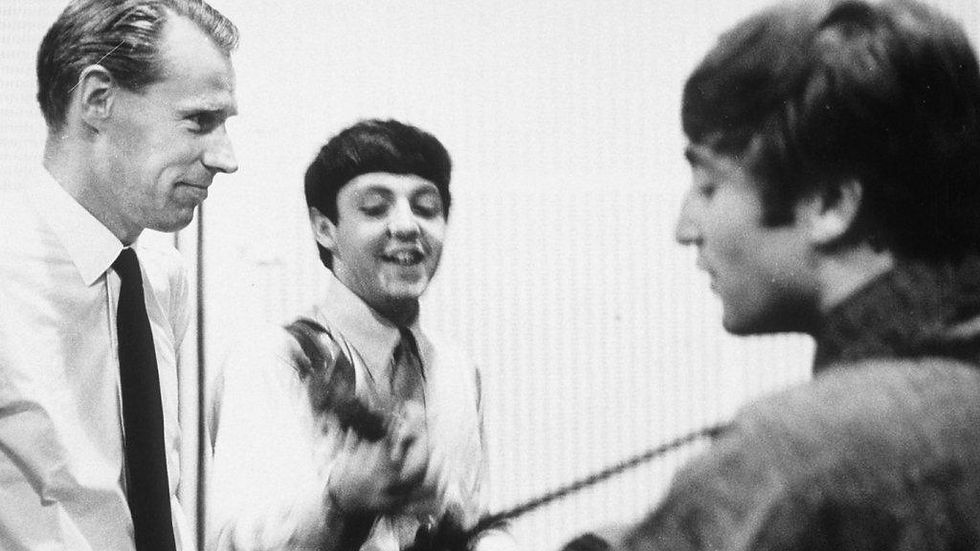
And of course, when belonging to these temporary emotional communities we can find some blessed relief from the condition that was, is, and always will be the defining genetic vulnerability of Homo sapiens … for a little while we feel less alone. A thought that might well have indirectly influenced the ultimate curation of the Our World programme that kicked off in the UK at 8pm on Sunday the 25th of June, 1967. The show included contributions from Leonard Bernstein, Franco Zeffirelli and Jean Miro, but was principally remembered by four twenty-somethings giving first ever performance of a little number that had the BBC had specially commissioned for the transmission as ‘a track that could be easily understood by viewers of all nations, regardless of language’ a challenge that John Lennon rose to by writing: “All You Need Is Love.”
DT
24th and 25th June, 2026
*both series were overseen by the Controller of BBC2 from 1965 to 1972, David Attenborough
**co-written with Jonathan Lynn
***Durkheim was working from the observations of the Warumungu nation contained in Walter Baldwin Spencer and Frances James Gillen’s 1904 fieldwork study The Northern Tribes of Central Australia.
****Cultivating a Global Identity, Joseph de Rivera and Harry A. Carson Journal of Social and Political Psychology, 2015.


Comments