


FIGURES IN A SOUNDSCAPE

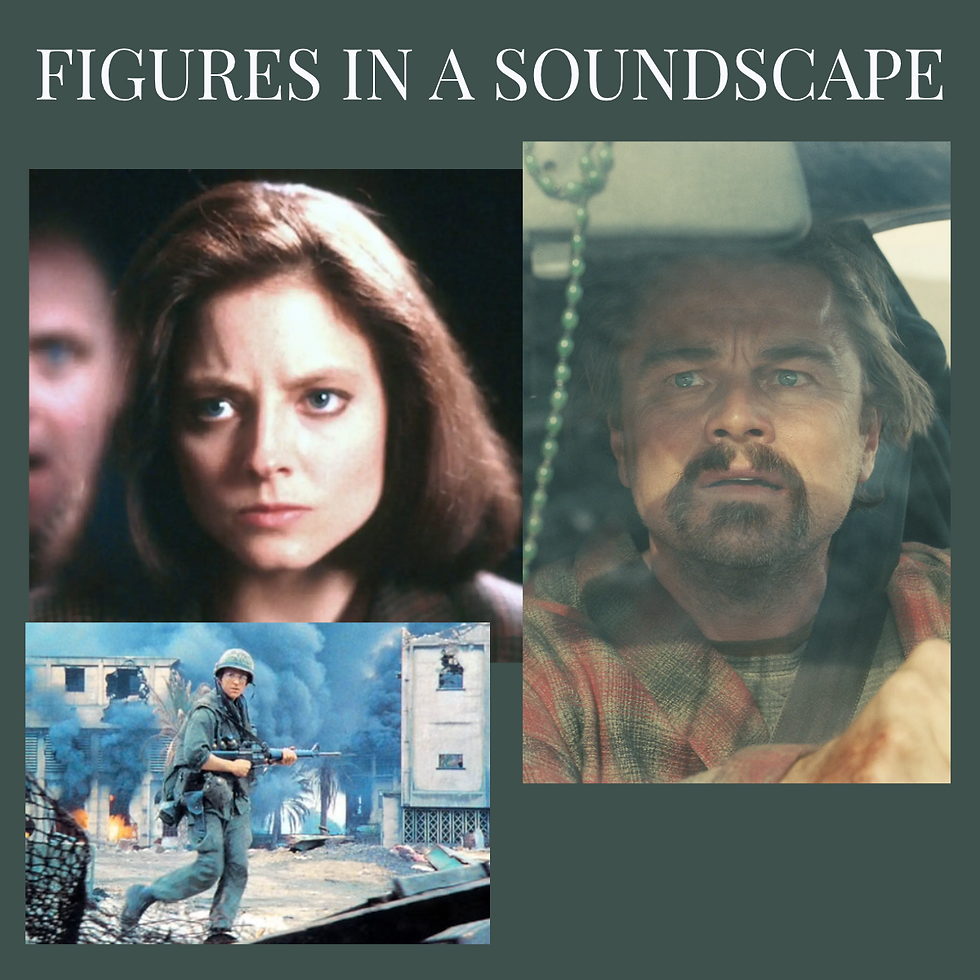
This week we direct our shell-likes towards some of the auditory techniques deployed to build on-screen suspense and reduce in-head tension
There’s been a lot going on these past twelve months. Frankly it’s just been one damn thing after another. So you can understand that the last thing I needed to stream was One Battle After Another. But you know, I think I needed to hear it. Because I honestly can’t recall any movie making such a no-holds-barred/take-no-prisoners assault on my lugholes since The Silence of the Lambs.
The Silence of the Lambs took 5 Oscar scalps, in addition to its on-screen ones.
One Battle After Another grabbed 6 statuettes, but was beaten to the top of the Sound Podium by Kosinski’s F1.
Both these magnificent movies used a devastating-by-design arsenal of auditory effects to induce or augment the suspense in the on-screen action and extend the tension; in short, to lure us out of the comfort of our cinema seats or sofas and plunge us head first into a dangerous, threat-filled world where we live, vicariously and temporarily, within the skin of the pursued.
Or, as an important 2015 paper described in more detail: *
‘…First, we define tension and suspense as affective states that (a) are associated with conflict, dissonance, instability or uncertainty, (b) create a yearning for resolution (c) concern events of potential emotional significance, and (d) build on future-directed processes of expectation, anticipation and prediction.'
Cinematic campaigns directed towards our mental states are generally co-ordinated across two fronts:
1) The film’s ‘soundscape’ in which diegetic auditory elements, i.e. sounds naturally suggested by the on-screen action, are distorted for psychoacoustic effect (think of the iconic heartbeat of drug smuggler Billy Hayes in the opening of Midnight Express) and/or augmented by abstract elements (when Clary met Hanny in his Baltimore dungeon-suite in The Silence of the Lambs, Skip Lievsay created a nerve-jangling low frequency drone by recording screams of pain, slowing them down, and then running them through electronic processors).
2) Non-diegetic music, i.e. music that we can hear but the film’s protagonists can’t. Way back in my Film School days (think Edison, Chaplin and Valentino) these scores were referred to as ‘Subtitles For The Blind.’
The paper quoted above later asks, under ‘The Paradox of Suspense:’
‘If tension experiences build on an urge for uncertainty reduction and processes of expectation, prediction, and anticipation, this raises the question as to how tension can be experienced over repeated exposures to a stimulus. Assuming that uncertainty is resolved after the first exposure, subsequent exposures should have lost their power to create tension or suspense…’
Well yes, except for the fact that some of the weapons of mood distortion regularly deployed in The Business of Pleasure tap into neurophysiological responses that long pre-date the advent of cinema seats and sofas; they reach back to the cribs of our childhoods and caves of our ancestors and far beyond. Take ‘Looming Sounds’ for example:
‘Likely for the sake of hazard prevention, looming sounds are perceived as more salient to listeners than receding ones, in a rather fast, probably automatic evaluation process; this effect is termed the “auditory looming bias.” As such it manifests in various forms, across species and ages: rodent studies demonstrate higher cortical activity while primates show increased attention towards looming signals. In humans, evidence of an automatic process has been found through stimuli imperceptibly rising in intensity, which lead to increased visual cortex activation. The auditory looming bias has shown its presence in loudness changes, through alertness to perceived speed and relative distance of objects, as well as overall reaction times. In line with an evolutionary explanation, the looming bias emerges stronger in physically weak or vulnerable people, as well as under mentally challenging conditions. Interestingly, behavioural indications for prioritizing auditory looms were demonstrated even in newborns as well as infants of 4 months of age, who most presumably are not yet aware of the hazard nature of approaching objects.’ **
But what about when we step out of the cinema or surgically detach our buttocks from the sofa?
One of the most powerful uses of diegetic music in the history of cinema (IMO) is delivered in Kubrick’s Full Metal Jacket. During their training back home the young boots, led by their drill instructors, vocalise chants to boost their group cohesion and self-images both as macho hombres and fighting men:
Ho Chi Minh is a son-of-a-bitch
Got the blue balls, crabs and the seven-year-itch
Mama and Papa were lying in bed
Mama rolled over, this is what she said
Ah, gimme some
Ah, gimme some
But when the trained young marines have actually faced real enemy fire in combat they instead seek comfort in a little ditty that evokes both the innocence and safety of their childhood homes, the Mickey Mouse Club March:
Who’s the leader of the club
That’s made for you and me
M-I-C-K-E-Y M-O-U-S-E
In a similar vein, when faced with the kind of boring and repetitive tasks that make little or no pressing demands on our cognitive capacities, the vacuum can oft-times be filled by self-doubt, uncertainties and anxieties. Then, in the exact antithesis of building cinematic suspense, we increasingly rely on our personal sound systems and reassuring content, music and audiobooks, to muffle the tension -if not drown it out completely.
According to recent surveys:
UK on-demand music consumers average 13 hours of listening a week, with 71% of that time spent listening alone.
The UK audiobook market has roughly tripled since 2016, while in 2025 40% of audiobook consumers reported that they had only started listening in the previous 12 months.
Among UK audiobook listeners surveyed, 28% listened while winding down for bed, 21% while commuting, and 20% while doing household chores.
Of course, there is a greener, battery-free method of mood distraction which the Broadway Chapter of The Business of Pleasure proposed some 75 years ago:
Whenever I feel afraid I hold my head erect And whistle a happy tune So no one will suspect ...
And for those of you unfamiliar with this dying art, I will leave it to the Hollywood Chapter to provide the refresher course.
“You know how to whistle, don’t you Steve?”
“You just put your lips together and blow.”
...while I get back to writing my audiobook.
DT 1st October 2026
* Toward a general psychological model of tension and suspense Moritz Lehne and Stefan Koelsch, Frontiers in Psychology 11 February 2015
** Neural Mechanisms Underlying the Auditory Looming Bias Karolina Ignatiadis, Diane Baier, Brigitta Tóth, Robert Baumgartner Auditory Perception and Cognition, 20 September 2021
* Toward a general psychological model of tension and suspense Moritz Lehne and Stefan Koelsch, Frontiers in Psychology 11 February 2015
** Neural Mechanisms Underlying the Auditory Looming Bias Karolina Ignatiadis, Diane Baier, Brigitta Tóth, Robert Baumgartner Auditory Perception and Cognition, 20 September 2021


Comments