


How do you produce a commercially successful West End Musical? (15 marks)

Updated: Sep 26
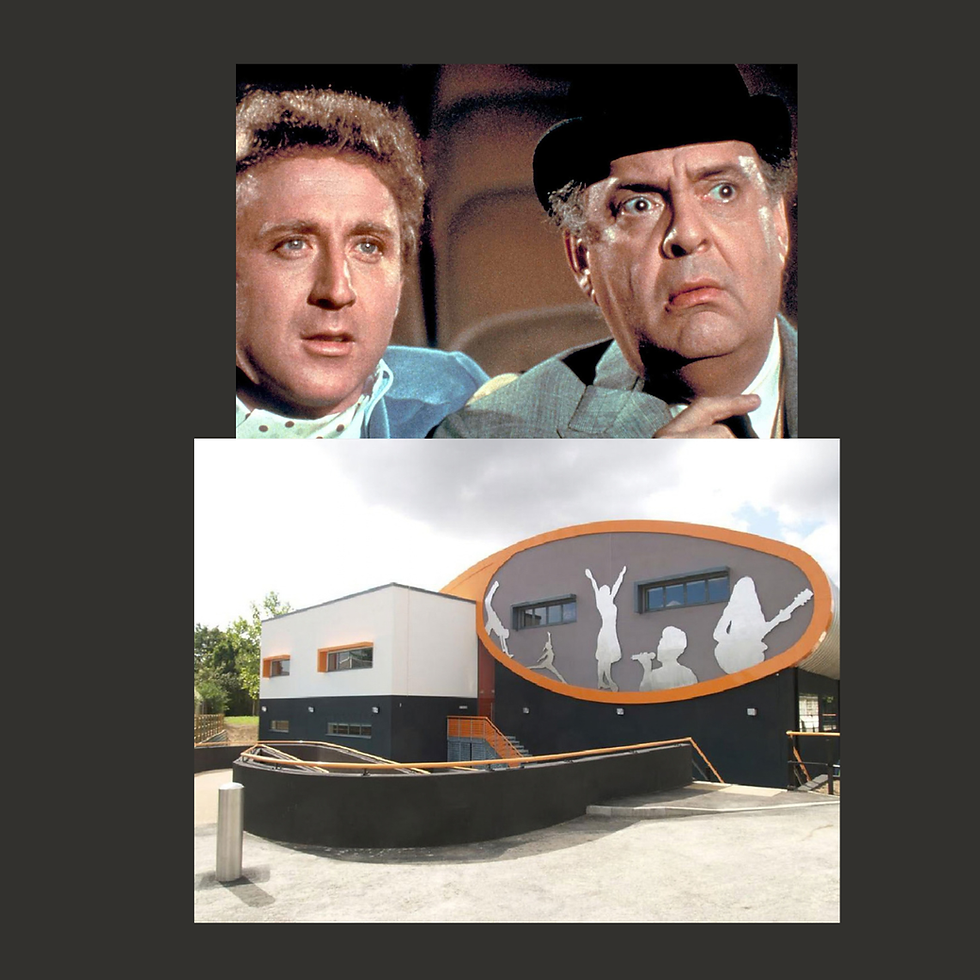
A couple of weeks ago my eldest shared a picture on Facebook. It showed three wide-eyed cherubs on their first day of Brit School. My own expression wasn’t that much different when we attended an introduction event. I have been very fortunate to work with some insanely engaged entertainment professionals in my career, but I have never seen so much passion under one roof as that little building near Croydon. I had two questions for the school’s Principal and Guiding Spirit, Stuart Worden.
DT: “On what criteria do you select your students?”
SW: “We talk to them. And if we think they’ll benefit from studying here, then they’re in. We do look at school reports as well, but you know …they’re all written by teachers.”
“DT: “Do you accept fifty-year-olds?”
On the basis of the above, I didn’t think that my extremely talented sixteen-year-old would have too much trouble getting onto the Brits Theatre Studies course, until I read one of the questions they’d set for their aspiring young candidates:
“How do you produce a commercially successful West End Musical?”
Sorry?
“How do you produce a commercially successful West End Musical?”
Right.
A similar question came up during a call yesterday, 37 years and two days after Miss Saigon opened at The Theatre Royal Drury Lane. The original London production ran ten years at The Lane, doubling the record set by My Fair Lady, with subsequent productions across the country, and the world, spanning right through to the present day and far, far, beyond.
Miss Saigon has something for everyone: Emotion, Comedy, Romance, Spectacle… in fact everything you need to help fill 2,184 seats, eight shows a week, 416 performances a year, for ten years …and in spite of 3 wars, a recession, a housing crash and Black Wednesday.
But it is the variation between different moods or emotions, and the transitions that take us from one mental state to another, that can make the ‘modern’ Musical* the most psychologically penetrative and universally accessible of art forms. This is, of course, my personal view, acquired over a couple of decades at the sharp end, but for once the science seems to back me up:
Changing the tune: listeners like music that expresses a contrasting emotion (2012)**
‘Theories of esthetic appreciation propose that (1) a stimulus is liked because it is expected or familiar, (2) a stimulus is liked most when it is neither too familiar or too novel, (3) a novel stimulus is liked because it elicits and intensified emotional response. We tested the third hypothesis by examining liking for music as a function of whether the emotion it expressed contrasted with the emotion expressed by the music heard previously. Stimuli were 30-s happy- or sad-sounding excerpts from recordings of classical music. On each trial, listeners heard a different excerpt and made liking and emotion-intensity ratings. The emotional character of consecutive excerpts was repeated with varying frequencies, followed by an excerpt that expressed a contrasting emotion...’
And when the results were in, and the subjects climbed down off the emotional roller coaster?
‘The analysis revealed four main findings: (1) listeners reported greater appreciation and a more intense emotional response when the music contrasted in emotional status to that of music heard previously, (2) liking and intensity ratings were correlated positively, (3) the contrast effect for liking disappeared when the intensity of listeners’ emotional responses were held constant, and (4) response patterns were similar whether the background emotion was happiness or sadness.’
And whereas as I have developed (and patented) my own system of at-a-glance metrics for evaluating a patron’s emotional engagement at any stage during a Musical:
1) fingers on tummy – hovering over the tingling enteric nervous system, home of those fluttering butterflies;
2) fingers on neck -the scene is getting more intense;
3) fingers covering mouth. Oh my gosh!
the scientists have, of course, gone one stage further.
Emotions in the Brain are Dynamic and Contextually Dependent: Using Music to Measure Affective Transitions (2025) ***
‘In everyday life, our emotions flexibly shift between states based on the temporal and social context. Our ability to move from one emotional state to the next in response to our environment is crucial to our well-being, and our ability to understand and predict these emotion transitions is crucial for forming social connections. Despite this, neuroimaging studies that have addressed the dynamic quality of emotions have largely focused on identifying brain regions that track the rise and fall of a single emotional state in response to stimulus… To bridge the gap, we partnered with musical composers to develop novel musical stimuli to induce a particular emotional reaction at specific periods of time…’
And when the fat lady had sung, and fMRI imaging had been analysed:
‘The aim of this study was to determine how the brain processes the dynamic and contextually dependent nature of emotions. By comparing within-emotional event versus across-emotional event temporal correlations in BOLD (Blood-Oxygen-Level-Dependent) signal recorded while participants listened to novel, emotionally evocative music, we found that brain state transitions in voxels (the 3D equivalent of a pixel) in the temporal lobe aligned with composer-defined emotion transitions. Using a probabilistic model, we then determined that emotion dynamics not only contribute to brain-state patterns in these regions but are one of the primary drivers of brain response to music…’
And while this particular study could not put the finger on ‘whether dynamic emotional experiences evoke different kinds of dynamics in subcortical areas, such as transitory responses at boundaries or ramping activities throughout events’ the writers could point to previous work in the area that might shed some light on the (grey) matter of transitions:
‘…Previous research has suggested that changes in context elicit changes in arousal, which segment our memories into separable events. Others have suggested that emotion dynamics arise as a result. Or the underlying and fluctuating uncertainty associated with trying to predict future outcomes. It could be that specific “types” of emotion transitions (e.g., negative to positive, more arousing to less arousing, or more uncertain to more certain) are specifically driving the event pattern in different ways..’
Of course, prospective Brit School students and aspiring Impresarios don’t need an fMRI analysis of what is happening to the audience at a neural level, but I do think they need to keep at least a weather eye on the show’s psychological Prompt Book.
And if they haven’t got the time to follow my finger-tip guide to audience engagement, there is another tried and trusted way to measure it …it’s called the Box Office Advance.
Naturally, there’s still the small matter of foraging for and finding, or forging together, a great story with a strong enough structure, narrative development, characters (with their own compelling individual and combined dramatic arcs) to accommodate your emotional roller-coater.
And assembling a team of world class creatives, cast, crew and commercial teams.
Plus finding the perfect venue, at the perfect time, with a brilliant Box Office and a management who understand (or can be taught) how to transform every performance into an event that lives long in the memory.
While sourcing the finance necessary to carry the show, and its sales and marketing, long enough to build up (and build out) a commercially sustainable audience that can carry you through the West End’s first couple of seasonal troughs -even if shouty elements in the Press and Social Media have got it in for you.
A chart-topping number or two covered by top-selling artists can also be quite useful.
And of course luck, lots and lots of it.
But if you have engineered and fine-tuned your emotional-dynamic engines correctly.
And have a genius at the controls (with top-flight co-pilot to step in when necessary)
There is nowhere you cannot take your audiences (or find them)
DT
2 September 2026
* As distinct from Musical Comedy, Pastiche, Jukebox Musicals Tickbox Musicals, etc.
** Changing the tune: listeners like music that expresses a contrasting emotion E. Glenn Schellenberg, Kathleen A. Corrigall, Olivia Ladinig and David Huron Frontiers in Psychology, 24 December 2012
***Emotions in the Brain Are Dynamic and Contextually Dependent: Using Music to Measure Affective Transitions. Matthew E. Sachs, Mariusz S. Kozak, Kevin N. Ochsner, and Christopher Baldassano eNeuro Research Article: Research Cognition and Behaviour, April 14, 2025

Comments