


Many Happy (and emotionally supercharged) Returns!

Updated: 1 day ago
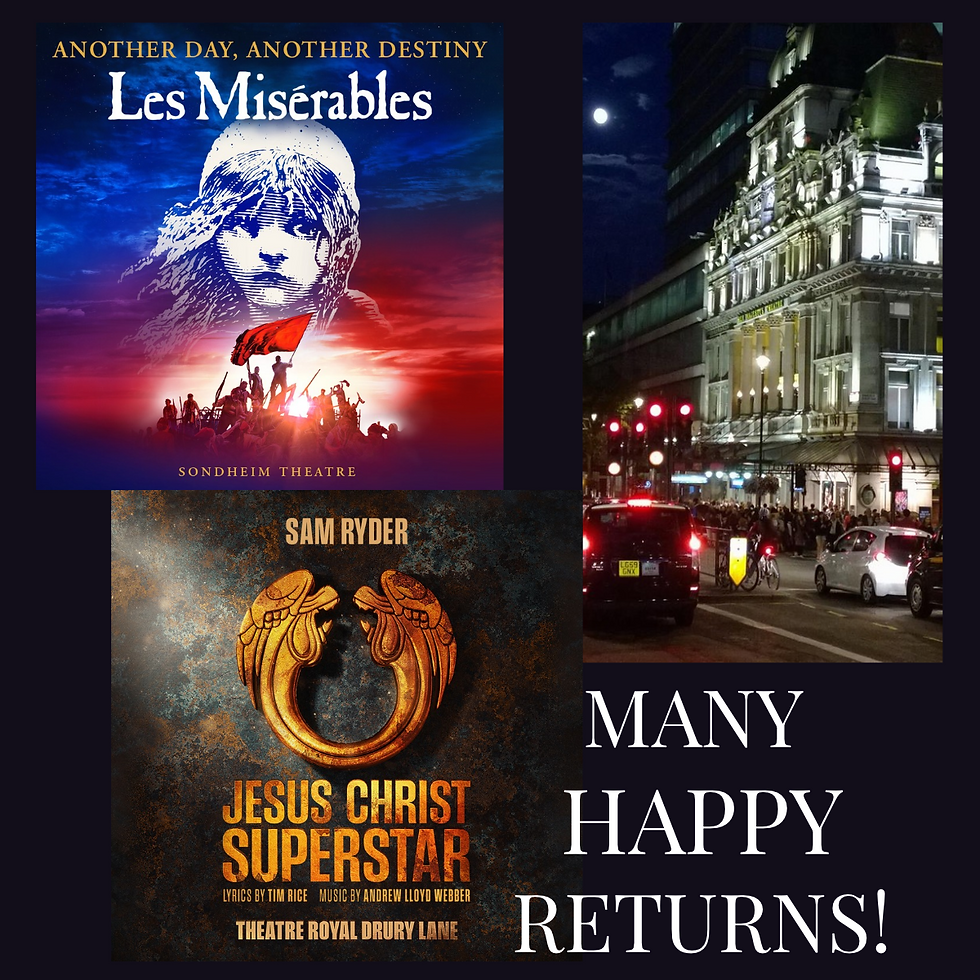
The week ahead will see celebrations right across the Musical Theatre Chapters of The Business of Pleasure to mark the anniversaries of three unquestionable masterpieces of the art form: Jesus Christ Superstar, opened 12 October, 1971, Les Misérables, 8th October 1985, and The Phantom of the Opera, 9th October, 1986.
All three of these foundational works of the post-war musical-theatre canon continue to work their magic on audiences just as powerfully today as when they exploded onto the world stage. And quite possibly even more so. A ‘modern’ musical is almost always a continuous work-in-progress, evolving with the inputs and impetus of new cast and creatives introduced. Similarly, over time, it will need to adapt to changes in the world of the patrons it serves, their attitudes, tastes and preoccupations, just as the show’s MD will take their cue from the audience reactions on the night.
But for one section of those audiences, namely adolescents and young adults, the experience may often be personally foundational, establishing a high-water-mark of emotional engagement that they may well return to again and again throughout their lives. This is due to a well-documented, if not fully understood, phenomenon called The Reminiscence Bump:
‘Several theoretical approaches have emerged to explain the RB, highlighting four leading theories (Munawar et al., 2018). For instance, the identity-formation account suggests that this life period accumulates significant events that serve the development and construction of identity (Conway and Holmes, 20024). The cognitive account postulates an increased effort of encoding necessary during the bump period because of the high amount of novel memories, while the cognitive-abilities account highlights the maturation of the brain and enhanced neurological functioning leading to an optimal encoding efficiency (Janssen, 2020; Koppel & Rubin (2016). In contrast, the life-script account (Berntsen and Rubin 2004) emphasises culturally shared knowledge about important transitional events in a typical life, commonly occurring during the bump period (e.g.., completing high school, starting a career, getting married), which might lead to a better recall.’ *
But don’t take my word for it, or the observations of scientists. The next time you’re fortunate enough to be experiencing Jesus Christ Superstar, Les Misérables or The Phantom of the Opera, take a closer look at the faces, and into the eyes, of the audience members around you. Those older patrons basking in the re-ignited memories of far-off days. Or those younger, fresher faces, laying down memories that they will be returning to for decades to come. The paper quoted above explains the unique power of music (and thus Musicals) in the creation of powerful, enduring memories as follows:
‘Music is a potent cue for autobiographical memory, which has been shown to elicit more vivid and embodied memories than any other sensory cues (Jakubowski et al., 2020). Music’s ability to evoke vivid long-lasting, emotionally charged memories may reflect its unique access to both emotional and autobiographical memory systems. Neuroscientific studies show that music engages brain regions involved in memory and emotion, including the hippocampus, the amygdala and medial prefrontal cortex (Belfi et al., 2016; Jamata 2009; Koelshc, 2014). These pathways may allow music to evoke memories through mechanisms that partially bypass language, a capacity that has been shown to be especially salient in populations with impaired language function such as individuals with Alzheimer’s disease (El Haj et al., 2012).’
But I don’t believe that’s the whole story. To me, personally, it is no coincidence that an up-and-coming younger generation, with all its romanticism and rebellions, takes centre-stage in all three shows (Jesus against the Pharisees, Marius and the students on the barricades, and Raoul v The Phantom).
A Musical is not just for Christmas (anniversaries, date-nights and birthdays, etc.).
Whenever and however we first experience the shows, or subsequently return to them, the memory pathways outlined above ensure that they are always on tap; a delivery system capable of providing an emotional jolt to the system any time we need 'a bit of a lift.’ A system reboot and settings restore powered by the intensity of the emotions with which the experience was first encoded, and reinforced every time we return to it. You could almost say that the price of the ticket includes a lifetime licence to remember, re-play, re-live and rejuvenate. ....But don't tell the CMA or we might need to include it in the ts & cs!
DT
First Published 4th October 2024/ Revised Version 7 October, 2026
*Memory bumps across the lifespan in personally meaningful music Iballa Burunat, Anastasios Mavrolampados, Suvl Hellna Saarikallio, Geoff Luck and Petri Tolvalnen Memory, 33; 10, 2025

Comments